Types of Coffee Beans: Everything a Wholesale Buyer Needs to Know About Every Variety
Types of Coffee Beans: Everything a Wholesale Buyer Needs to Know About Every Variety
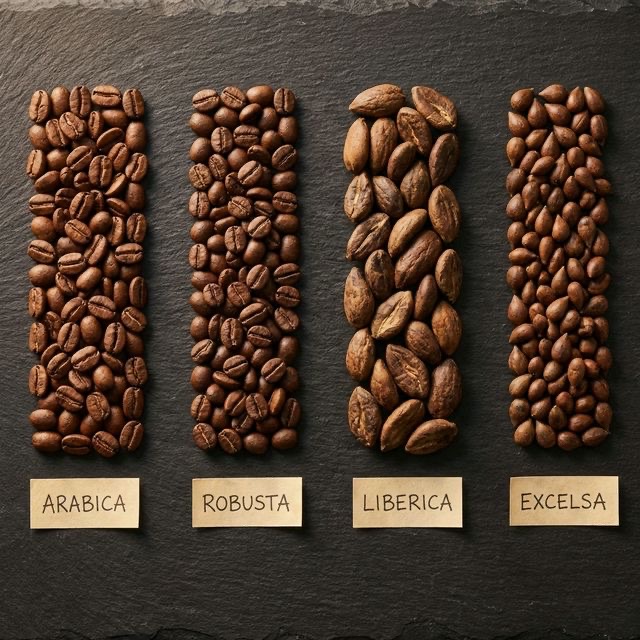
Most articles about types of coffee beans will tell you there are four: Arabica, Robusta, Liberica, and Excelsa. That’s technically correct, but practically useless for anyone actually buying coffee at wholesale. The real story is far more nuanced — and the differences within Arabica alone matter more to your business than the difference between all four species. Let me challenge some common assumptions and give you the information that actually affects purchasing decisions.
Whether you’re purchasing green beans for roasting, developing a new product line, or trying to understand what your supplier is offering, this guide covers what each type actually means for wholesale quality, pricing, and market positioning.
The Four Species of Commercial Coffee
| Species | Global Share | Flavor Character | Price Range (Green) |
|---|---|---|---|
| Arabica (Coffea arabica) | ~60% | Sweet, complex, acidic | $3.50–$25.00+/kg |
| Robusta (Coffea canephora) | ~38% | Bold, bitter, high caffeine | $1.50–$4.00/kg |
| Liberica (Coffea liberica) | ~1.5% | Woody, smoky, floral | $2.00–$6.00/kg |
| Excelsa (Coffea excelsa) | ~0.5% | Tart, fruity, complex | $3.00–$8.00/kg |
Arabica: The Species That Actually Has Varieties Worth Knowing
Here’s where most “types of coffee beans” articles stop being useful. They mention Arabica and move on. But within Arabica, there are hundreds of cultivated varieties — and the variety you’re buying affects cup quality, yield, disease resistance, and market value dramatically.
Heritage Varieties (Highest Cup Quality)
These are the varieties that built the specialty coffee industry. They typically produce lower yields but superior and more complex flavor profiles.
- Typica: The original Arabica variety from Ethiopia. Produces elegant, clean cups with mild body and sweet acidity. Low yield makes it increasingly rare in commercial production.
- Bourbon: A natural mutation of Typica that developed on Reunion Island (formerly Bourbon). Known for deep sweetness, balanced complexity, and excellent cupping scores. Key variety in Central and South America.
- SL-28 and SL-14: Varieties developed at Scott Agricultural Laboratories in Kenya. SL-28 produces legendary blackcurrant and citrus complexity. SL-14 thrives in Uganda’s Mt. Elgon region, delivering chocolate, stone fruit, and bright citrus notes that score consistently in the specialty range.
- Geisha/Gesha: Originally from Ethiopia’s Gesha village, this variety produces extraordinarily floral, tea-like, and jasmine-scented coffee. Commands the highest prices in specialty — competition lots regularly sell for $50–$200+/kg at auction.
Modern Hybrids (Balanced Yield + Quality)
These varieties were bred to combine disease resistance and higher yields with acceptable cup quality.
- Catimor: Cross between Caturra and Timor Hybrid. High disease resistance, good yield, but cup quality can be astringent at lower altitudes. Performs better above 1,400m.
- Castillo: Developed in Colombia as a rust-resistant alternative. Controversial in the specialty community — some lots cup well, others lack complexity.
- Ruiru 11: Kenyan hybrid bred for disease resistance. Compact trees with higher yields than SL varieties. Cup quality is improving as selection continues.
- Marsellesa: One of the newer F1 hybrids showing genuine promise — high yield, good disease resistance, and cupping scores that compete with heritage varieties.
Why Variety Matters for Your Wholesale Business
When你’re buying green coffee, the variety tells you more about potential cup quality than almost any other specification. A washed SL-14 from Uganda at 1,800 meters will almost certainly produce a different (and generally better) cup than a Catimor from the same altitude. Ask your supplier which varieties are in each lot — if they can’t tell you, they probably don’t have the origin relationships necessary for consistent quality sourcing.
Robusta: Challenging the Cheap Label
Here’s my contrarian take: the wholesale industry’s dismissal of Robusta as “cheap and bitter” is outdated and costs you money. Fine Robusta (yes, that’s a real category) is emerging as a legitimate specialty segment, and even commercial-grade Robusta serves important roles in your product lineup.
Where Robusta Adds Value
- Espresso blending: A small percentage (10–20%) of quality Robusta in an espresso blend adds crema, body, and a flavor backbone that pure Arabica blends sometimes lack.
- Caffeine content: Robusta contains roughly twice the caffeine of Arabica. For products marketed on energy and strength, this is a feature, not a defect.
- Instant coffee production: Most soluble coffee uses Robusta for its bold, punchy flavor that survives the processing.
- Price stability: Robusta pricing is significantly less volatile than Arabica, providing more predictable cost modeling for high-volume operations.
Fine Robusta: The Emerging Category
Uganda produces some of the world’s best Robusta — the country is actually the second-largest coffee producer in Africa, with Robusta accounting for about 80% of its total output. Well-grown, carefully processed Ugandan Robusta delivers dark chocolate, woody, and nutty notes without the harsh bitterness of poorly handled commercial Robusta.
The Coffee Quality Institute now certifies Fine Robusta with a dedicated cupping protocol. Coffees scoring above 80 on the Fine Robusta scale are genuinely interesting and commercially valuable, trading at premiums well above commodity Robusta pricing.
Liberica and Excelsa: Niche but Worth Understanding
Liberica
Grown primarily in the Philippines, Malaysia, and parts of West Africa, Liberica beans are visibly larger and asymmetrical compared to Arabica. The flavor profile is polarizing — woody, smoky, sometimes fruity, with a much heavier body. Liberica represents a tiny fraction of global production and is rarely available through standard wholesale channels. Its primary commercial value is in the domestic markets of producing countries.
Excelsa
Reclassified as a variety of Liberica in 2006 (though the market still treats them as distinct), Excelsa produces complex, tart, fruity cups that some blenders use as unusual accent components. It’s mostly grown in Southeast Asia and represents less than 1% of global production. You’re unlikely to encounter Excelsa in wholesale catalogs, but it occasionally appears as a novelty offering from specialty importers.
How to Choose the Right Bean Type for Your Business
If You’re a Specialty Roaster
Focus on heritage Arabica varieties from known origins with full traceability. SL-14 and SL-28 from East Africa, Bourbon from Central America, Typica from anywhere performing well. Your customers pay for variety-specific flavor characteristics — give them genuine diversity.
If You Supply Commercial Cafés
High-quality Arabica (modern hybrids are fine) for your core offerings, with strategic Robusta inclusion in espresso blends for body and crema. Consistency and value matter more than exotic variety names.
If You’re Building a Product Line
Consider variety as a differentiator. “100% SL-14 Ugandan Arabica” tells a more compelling story than “100% Arabica” — and it justifies the premium pricing your margins depend on.
The Bottom Line for Wholesale Buyers
Understanding varieties of coffee beans at the species level is table stakes. Understanding varieties within Arabica — and increasingly, quality tiers within Robusta — is what separates informed buyers from those relying on their supplier’s sales pitch. Ask better questions about the coffee you’re buying, demand variety-level information, and use that knowledge to build products that command premium positioning in your market.
Swab Dealers specializes in SL-14 Ugandan Arabica from Mt. Elgon, with full variety documentation and lot-level traceability. We also offer Fine Robusta from Uganda’s central region for quality-focused espresso blending programs.
Request Variety-Specific Samples →