The Economics of Bulk Coffee: Why Sourcing Ugandan Arabica is the High-Margin Strategy for 2026
In the volatile landscape of global commodities, coffee wholesalers and distributors face a dual challenge: rising operational costs and an increasingly discerning consumer base. As we approach 2026, the traditional reliance on massive Brazilian and Colombian imports is being heavily scrutinized by savvy CFOs and Purchasing Managers. The wholesale coffee market data is explicitly clear—commercial buyers are aggressively hunting for the most competitive coffee price per kg, indicating a massive pivot toward cost-efficiency without compromising cup quality.
This analysis explores why Single-Origin Ugandan Arabica has emerged as the definitive high-margin asset for food wholesalers, coffee shops, and commercial roasters. We will dissect the granular economics of bulk coffee beans and demonstrate exactly how diversifying your origin portfolio can permanently inoculate your business against wild market fluctuations.
1. The Economic Reality: Price vs. True Value
The global commerce data for the 2024-2025 importing period reveals a highly telling trend. High-intent B2B search terms targeting wholesale coffee beans and bulk coffee supply are commanding fierce competition. This strictly indicates that the retail market is entirely saturated with aggressive buyers desperately searching for viable, long-term supply partners.
However, smart money is moving rapidly toward specific efficiency metrics. We are seeing commercial roasters calculating green coffee yields down to the exact gram to justify the cost of green coffee imports. In this ruthless equation, Ugandan Arabica shines. It inherently offers a heavy density and uniform bean size (often Screen 15+), which directly ensures a lower defect count and significantly higher roast yield compared to similarly priced Central American varietals.
📈 Market Insight:
While generic consumer terms have millions of superficial searches, the real commercial intent lies in securing reliable wholesale coffee suppliers who can deliver green coffee beans at scale. Businesses actively sourcing these resources are looking for multi-year contracts, not one-off micro-lot bags. Sourcing Ugandan beans empowers you to offer highly competitive frontend pricing on these contracts while quietly retaining a massive backend margin.
2. The Roaster’s Calculus: Commercial Consistency
For a commercial coffee roaster, consistency translates directly into currency. Any variability in screen size or moisture content can completely wreak havoc on automated roast profiles, leading immediately to wasted batches and lost revenue. There is a new wave of coffee roasting businesses entering the market, and these expanding setups require robust, forgiving, and highly consistent beans.
Ugandan Arabica, particularly from the nutrient-rich Mt. Elgon region, is deeply celebrated for this structural consistency. It easily withstands darker roast profiles—often strictly required for traditional espresso blends—without losing its structural integrity or developing cheap, ash-like flavors. This makes it a perfect foundational candidate for our Roastino Dark Roast Premium line, reliably providing the heavy body and rich crema that retail consumers actively demand.
3. Analyzing the Margin: Uganda vs. The World
To fully understand the financial advantage, we must aggressively look at the comparative economics of global sourcing. Below is a strategic comparison of Ugandan Arabica positioned against the traditional heavyweights dominating the wholesale sector.
| Origin | Average Wholesale Cost Index | Flavor Profile Complexity | Acidity Level | Est. Margin Potential |
|---|---|---|---|---|
| Uganda (Arabica) | Medium | High (Citrus, Chocolate, Nutty) | Balanced / Bright | ⭐⭐⭐⭐⭐ (Highest) |
| Ethiopia (Yirgacheffe) | High | Very High (Floral, Tea-like) | Very High | ⭐⭐⭐ (Volume constrained) |
| Brazil (Santos) | Low | Low (Nutty, Flat) | Low | ⭐⭐⭐⭐ (Volume dependent) |
| Colombia (Supremo) | Medium-High | Medium (Caramel, Fruit) | Medium | ⭐⭐⭐ (Market saturated) |
As the data table clearly demonstrates, Uganda occupies an incredibly lucrative “Goldilocks zone.” It offers the startling flavor complexity usually reserved for expensive Ethiopian specialty lots, but does so at a price point hovering much closer to Brazilian commercial staples. For coffee distributors actively looking to supply premium coffee beans to major clients, exploiting this exact arbitrage opportunity is the absolute key to 2026 profitability.
4. The Supply Chain Advantage for Distributors
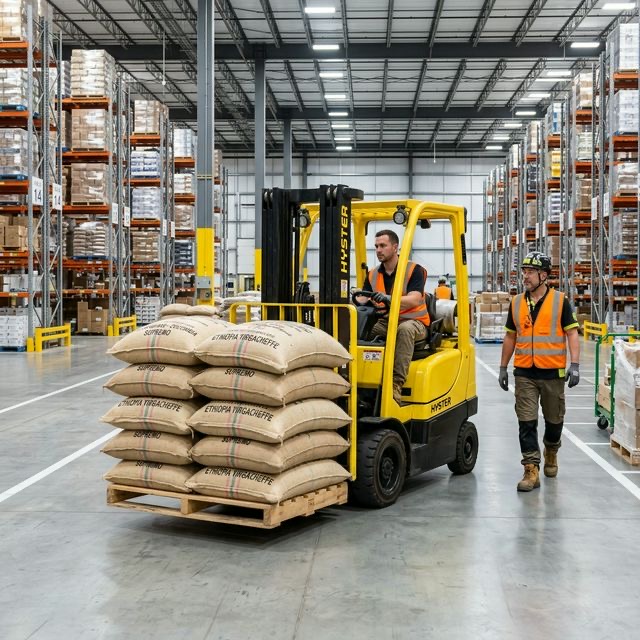
Reliability is the silent killer of modern coffee businesses. The rising anxiety surrounding logistics highlights exactly why local coffee shops and major wholesale coffee distributors are terrified about supply chain continuity. Ugandan agricultural production cycles differ slightly from South America, reliably offering fresh harvest arrivals precisely when other origins are fading from the market.
By heavily integrating Ugandan stock, specifically our Ugandan Wholesale Revolution beans, distributors can effectively smooth out their painful inventory curves. You are no longer held at the utter mercy of a sudden frost in Brazil or a container shipping strike out of Vietnam. You firmly hold a robust, direct-trade supply line straight to East Africa.
Green Coffee: The Roaster’s Greatest Asset
For those aggressively targeting the unroasted green coffee wholesale market, Uganda represents massive, untapped potential. Many novice roasters are completely unaware that Uganda produces premium Arabica at all, casually assuming it is strictly a Robusta-only origin. Educating your B2B clients about this—perhaps by directing them to our comprehensive guide on Sourcing the Best African Coffee—instantly positions you not just as a transactional vendor, but as an indispensable, knowledgeable partner. This actively builds radical loyalty, which is the ultimate driver of Lifetime Customer Value (LTV).
Secure Your 2026 Supply Chain Today – Sourcing Ugandan Arabica Coffee
Don’t let sheer market volatility eat into your hard-earned margins. Request a quote for our bulk Ugandan Arabica today and instantly lock in direct-trade pricing that makes structural sense for your bottom line.
Request a Wholesale Quote5. FAQ: Sourcing & Logistics
Conclusion
The supply data for the coming year is completely unambiguous: the global B2B market is desperately searching for verifiable value, unwavering consistency, and structural reliability. By rapidly pivoting your sourcing strategy to directly include high-quality Ugandan Arabica, you firmly align your business with the financial realities of 2026. You stop competing safely on brand name alone and finally start competing aggressively on margin and cup quality.
Whether you are looking for bulk coffee to custom-roast yourself or a reliable wholesale supplier for your entire distribution network, Swab Dealers acts as your direct, uncompromised gateway to the Pearl of Africa.