The global coffee supply chain is at an inflection point. While most roasters scramble for shrinking Brazilian and Colombian lots, a quiet revolution is brewing in East Africa—one that’s forcing wholesalers to rethink everything they know about sourcing wholesale green coffee beans.
Here’s what the data won’t tell you: Uganda, the continent’s second-largest coffee producer, has become the testing ground for a new model of coffee commerce. One where direct trade coffee isn’t just an ethical checkbox, but a competitive advantage. Where sustainable coffee beans command premiums not because of marketing, but because of measurable quality improvements in the cup.
If you’re still treating Uganda coffee as a gap-filler or low-cost alternative, you’re missing the story—and the margin.
The Commodity Trap: Why Traditional Coffee Suppliers Are Losing Ground
For decades, the wholesale coffee game has been straightforward: buy green coffee beans in bulk, negotiate on price, manage logistics, repeat. The C-market dictated terms. Coffee suppliers for small businesses acted as intermediaries, adding margin but rarely adding value.
That model is fracturing.
Climate volatility in traditional growing regions has made supply predictability a luxury. Brazilian frosts, Central American leaf rust, Vietnamese drought—each crisis sends shockwaves through the coffee supply chain, forcing wholesalers into reactive purchasing patterns that erode profitability.
Meanwhile, consumer preferences have evolved beyond recognition. Third-wave roasters demand traceability. Specialty cafés want origin stories. Even mainstream buyers are questioning the sustainability credentials of their unroasted coffee beans wholesale suppliers.
The old playbook doesn’t work when the rules have changed.
Uganda’s Arabica Advantage: The Case for Strategic Repositioning
Uganda’s coffee sector represents something rare in commodity markets: genuine structural opportunity.
1. Geographic Diversification
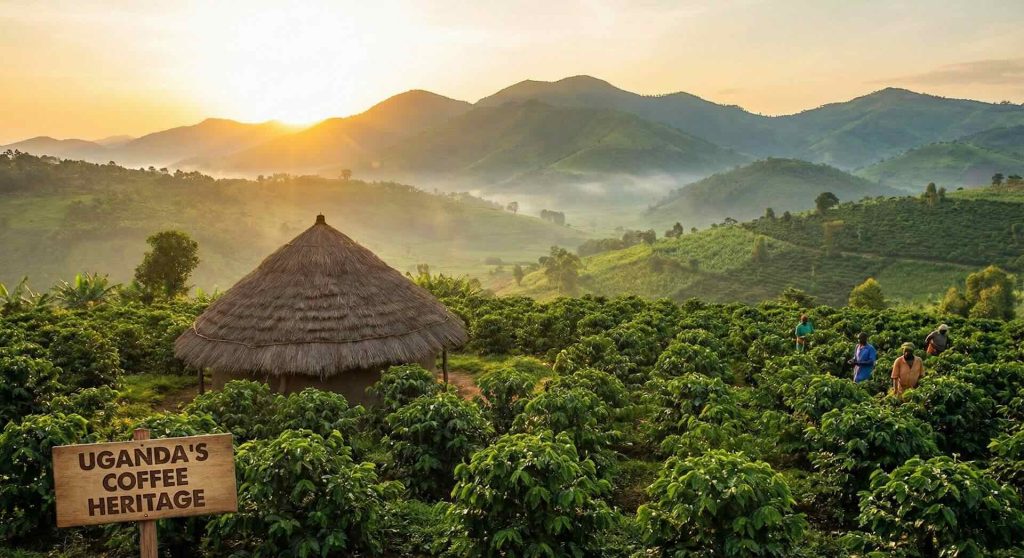
While other origins grapple with climate uncertainty, Uganda’s high-altitude growing regions—particularly Mount Elgon, Rwenzori, and the southwestern highlands—offer microclimates that produce exceptional Arabica. These aren’t marginal lots. We’re talking about washed coffees scoring 84-87 on the SCA scale, with flavor profiles that rival Kenyan AA at significantly lower price points.
2. Supply Chain Transparency
The proliferation of farmer cooperatives and washing stations has compressed the value chain. When you buy green coffee beans directly from Ugandan cooperatives, you’re often dealing with just one intermediary between farm and container. Compare that to the five-to-seven touchpoints common in Central American supply chains. Fewer handoffs mean better pricing control and legitimate traceability—not the manufactured kind.
3. Sustainability as Infrastructure
Ugandan producers aren’t new to sustainable coffee beans cultivation—they’ve been practicing organic farming out of necessity for generations. Now, formal certifications (Rainforest Alliance, UTZ, Fair Trade) are catching up to existing practices. For wholesalers, this means accessing certified sustainable lots without paying the “conversion premium” that accompanies newly-certified farms elsewhere.
💰 The Direct Trade Calculus
Is direct trade coffee actually worth the operational complexity? If you’re moving containerloads with razor-thin margins, traditional brokerage might still make sense. But if you’re positioning as a premium supplier—particularly to specialty roasters or mission-driven brands—the math becomes compelling.
Fixed-price contracts with cooperatives provide budget certainty that commodity purchasing can never offer. In a market where green coffee prices can swing 30% in a quarter, that’s not idealism—it’s risk management.
Request a Quote for Direct Trade LotsTraditional vs. Modern Wholesale Sourcing
The shift isn’t just about origin; it’s about the mechanism of trade. Here is how the landscape is shifting for buyers of wholesale green coffee beans.
| Feature | Traditional Commodity Model | Modern Direct Trade (Uganda Focus) |
|---|---|---|
| Pricing | Tied to volatile C-Market swings | Quality-based, often fixed-price contracts |
| Traceability | Country or Region level only | Down to the Cooperative or Washing Station |
| Risk Management | Reactive to global shocks | Proactive relationship-based stability |
| Quality Control | Standardized, bulk grading | Custom processing specs (moisture, screen size) |
| Sustainability | Compliance-focused (checkbox) | Integrated into farming infrastructure |
Sourcing Strategies for Wholesalers: A Framework
If you’re serious about integrating Ugandan Arabica into your offerings, here’s the strategic approach:
- Start with sample lots. Before committing to container quantities, source 30-60kg samples. Work with your roaster clients to cup and profile. Ugandan Arabicas often surprise buyers accustomed to Central American brightness—expect more body and chocolate-forward notes. You can explore our bright light roast profiles to see this potential in action.
- Build relationships, not transactions. The cooperative model means your contact isn’t a trader optimizing quarterly profits—it’s a collective of 500-2,000 farmers. Invest in visiting origins.
- Leverage blending opportunities. Ugandan Arabica excels in espresso blends, adding body and sweetness that complements brighter Central American components. For coffee suppliers for small businesses, this is a margin-positive way to introduce Ugandan lots while managing risk.
- Quantify the sustainability. Don’t just say “sustainable.” Use data. Sustainable coffee beans sell better when backed by metrics, such as carbon footprint reduction or income increases for partner cooperatives.
The 2025 Opportunity: Why Now Matters
The convergence of factors makes this moment unique for buyers of unroasted coffee beans wholesale. Global roasters are actively diversifying sourcing to mitigate climate risk. Investment in Ugandan washing stations has accelerated, meaning quality improvements are compounding.
Crucially, buyer awareness still lags quality improvements—creating a window where informed wholesalers can secure advantageous contracts before the market fully reprices Ugandan Arabica. The coffee suppliers capturing this opportunity won’t be the largest. They’ll be the ones who recognized that in commodity markets, information asymmetries create profit opportunities.
The revolution won’t be instant-brewed. But for those paying attention, the opportunity is already percolating.